
After a hail storm in Winnipeg, the real damage to your roof isn’t always what you’d expect. Asphalt shingles can lose granules in a hail strike without showing a visible mark, and a roof that looks fine from the ground can have impact damage that won’t cause leaks until next spring. The dings on your car after a storm are often the clearest sign there’s something worth investigating. Hail large enough to dent metal is large enough to damage shingles.
Hail-prone neighbourhoods change with every event, but parts of South Winnipeg, Fort Richmond, and Linden Woods have been hit hardest in recent years. Trudel Roofing is HAAG-certified, and the documentation we produce includes the detail insurance companies need when reviewing a claim.
We start with a documented HAAG-standard assessment of your roof, walk you through what we found, and then deal with your insurance company directly, including meeting the adjuster on site. If the claim is approved, we book the repair using CertainTeed Landmark shingles and finish with the same magnetic sweep cleanup we do on every job.
The work starts before any shingles come off. We come out, climb the roof, and document every impact strike (size, location, severity) with photos and notes that map to your roof’s specific layout. Insurance companies like to see detailed documentation of storm damage, and the work we do is built around producing exactly that.
Once the assessment is done, we walk you through what we found and what it means. If the damage is real and warrants a claim, we explain the process and help you contact your insurance company. From there, we deal with the adjuster directly. We’ll meet them on site, walk the roof together, and make the case for the work that needs doing. You don’t need to be there for any of it unless you want to be.
If the claim is approved, we book the repair or replacement. We use CertainTeed Landmark shingles for any reshingling work, install new flashing wherever we touch a penetration, and finish with the same magnetic sweep cleanup we do on every job. For storm damage that extends beyond hail (wind-lifted shingles, branches through the roof, water intrusion) see our storm damage roof repair page.
A hail damage roof inspection means getting up on the roof. We climb it, check each slope, and record what we find on every surface hail touches: the shingle field, the metal flashing at chimneys and vents, the eavestroughs, and the fascia. Every impact strike is photographed and noted against your roof’s layout, so the report reflects your roof rather than a general storm report for the neighbourhood.
You get the report by email with the photos attached, and a phone call to walk through what it means. If there is nothing worth claiming, the report will say that.
On asphalt shingles, hail shows up as granule loss and as cracks or dents from larger stones. It also marks the metal flashing around penetrations and dings aluminum eavestroughs and fascia. Not every hail event causes damage, and not all damage is obvious, which is why a HAAG-standard roof inspection matters more than a quick visual from the ground.
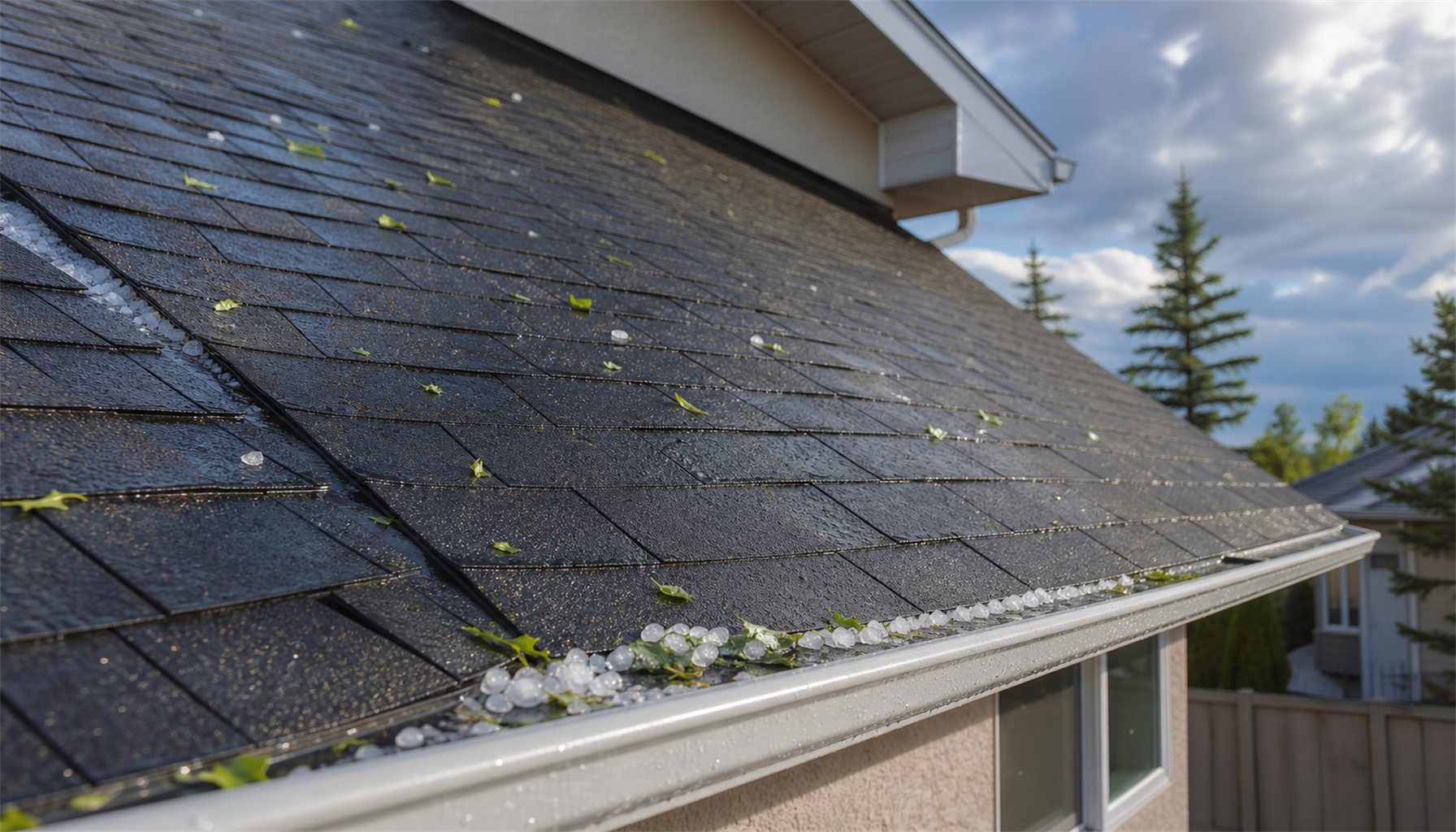
When a hailstone hits an asphalt shingle, it knocks loose the protective granules that block UV. You’ll see dark “bruised” spots on the shingle surface where granules are missing, and the granules themselves end up in your eavestroughs and downspouts. Loss like this isn’t a leak today, but it cuts the lifespan of the shingle dramatically. UV exposure on the exposed asphalt accelerates the breakdown.
A hailstone large enough to crack a shingle leaves a visible split or dent in the surface. These shingles will leak, sometimes within months, sometimes after the next big freeze-thaw cycle.
The metal flashing around chimneys, skylights, and vents shows hail dents clearly. Damaged flashing is one of the easiest ways for water to get behind the shingles and into the attic.
Dents in aluminum eavestroughs and fascia are usually the first thing homeowners notice. If your eavestroughs are dented, your roof very likely has damage too, and the eavestroughs themselves may need replacement as part of the claim.
Hail damage assessment is its own specialty, separate from regular roofing. The way you find damage, document it, and quote the repair takes specific training and experience. We’ve been doing this work in Winnipeg for years, and the HAAG credential backs it up.
The questions we hear after a Winnipeg hail storm are practical ones: how to tell if the damage is bad enough to look at, what a roof inspection involves, and how long you have to act on it. Plain answers below.
You usually can’t tell from the ground. Look at your eavestroughs first. Dents in the aluminum mean the hail was large enough to damage shingles. Check downspouts for granules washed out by the storm, and walk your yard for shingle pieces. If any of those are present, book a roof inspection. Cosmetic damage to a car after a storm is a strong signal there’s roof damage too.
No. We just need access to the property and a way into the back yard if your roof has slopes that aren’t visible from the street. We’ll send you the assessment report by email, with photos, and follow up by phone to walk you through what we found.
The deadline varies by insurer, but most Manitoba policies require claims to be reported within a few months of the storm. The longer you wait, the harder it is to prove the damage is from that specific event rather than later weather. If a storm came through recently and you’re not sure, book a roof inspection now and decide on the claim after.
If a storm came through your neighbourhood and you’re wondering whether to call your insurance company, get in touch first. We’ll come take a look and tell you straight whether there’s damage worth filing on.
Monday – Friday: 8:00 AM – 4:00 PM
Saturday: Closed
Sunday: Closed